Ballot Issue 5A · November 3, 2026

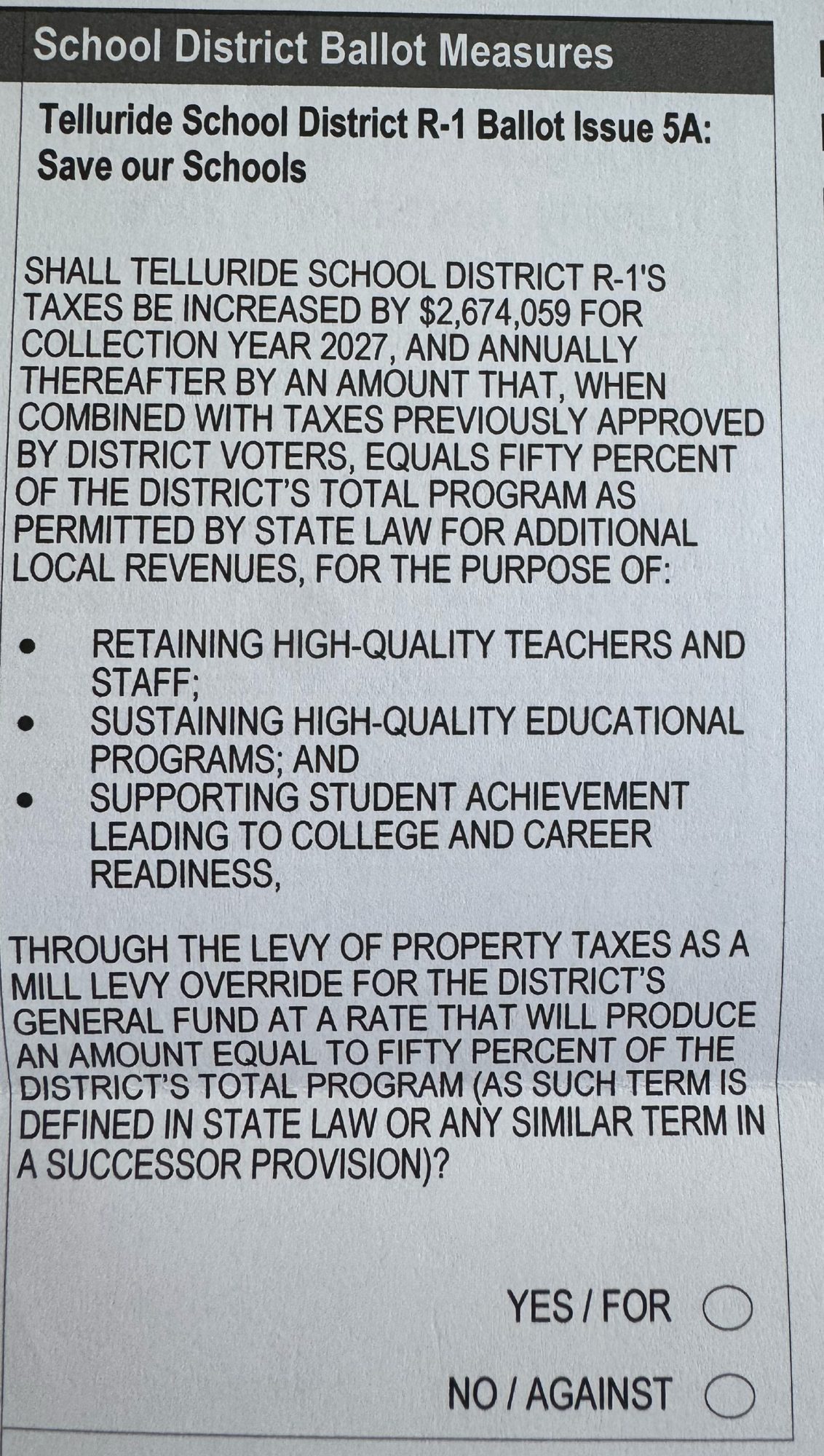
What the 5A ballot language actually says
Tax ballot questions have to use legal wording. Here's what 5A does, and what it can't do, in plain English.
The short answer
Every school district in Colorado gets a base funding number from the State. State law lets a community's voters add up to 50% on top of that base to support their own schools. Telluride voters already add 30%. 5A raises that to 50%, the maximum the law allows.
- It's not a 50% tax increase. It's a 50% add-on to the State's base number. For a homeowner, the cost is about $1 a month per $100,000 of home value (about $12 a year).
- It's not open-ended. 50% is the ceiling in state law. Going higher would take another vote of Telluride residents.
- It doesn't grow with home prices. The district collects a set amount each year. If property values go up, the tax rate goes down to match.
The money can only be used for teachers and staff, educational programs, and student achievement, as printed on the ballot.
The ballot, line by line
- 1
Year one: about $2.67 million.
Colorado law requires a tax question to start with “Shall taxes be increased…” and to state the first-year dollar amount. That amount is $2,674,059 in 2027. For a home, that works out to about $1 a month per $100,000 of value.
Ballot text
Shall Telluride School District R-1's taxes be increased by $2,674,059 for collection year 2027…
- 2
After year one, the amount follows the State's formula.
The State calculates a base funding number for Telluride every year. Voters already add 30% on top of it. 5A raises the add-on to 50%. That is 50% of the State's base number, not 50% of your tax bill and not 50% of the district's budget.
Ballot text
…and annually thereafter by an amount that, when combined with taxes previously approved by district voters, equals fifty percent of the district's total program…
- 3
50% is the ceiling, not a starting point.
State law sets 50% as the most any district can add. 5A asks for that maximum. There is no way to go above it without another vote.
Ballot text
…as permitted by state law for additional local revenues…
- 4
The money can only go to the purposes listed.
This is money for people and programs, not buildings. Buildings and teacher housing were the 2023 bond (4A), which by law cannot pay salaries.
Ballot text
…for the purpose of: retaining high-quality teachers and staff; sustaining high-quality educational programs; and supporting student achievement leading to college and career readiness…
- 5
The rate adjusts so the district collects a set amount.
Each December the school board sets the tax rate needed to collect the approved amount, in a public meeting. If property values across the district rise, the rate falls. Your own bill can still move if your home is reassessed differently from the district as a whole.
Ballot text
…through the levy of property taxes as a mill levy override for the district's general fund at a rate that will produce an amount equal to fifty percent of the district's total program…
- 6
A legal placeholder.
If the State ever renames its funding formula, this clause keeps 5A pointing at the new name. It does not raise the percentage or change what the money can be spent on.
Ballot text
…(as such term is defined in state law or any similar term in a successor provision)?
So is it open-ended?
No. It has no expiration date, but it is capped. After 2027 the amount is 50% of the State's base number for Telluride, every year, and the school board cannot go above that. If the State's number goes down, the amount goes down with it.
The State's new formula reduces Telluride's per-student funding by about 17% as it phases in. See the district forecasts and the school funding explanation for how this affects future revenue.
See how school funding worksFair questions
Is this a 50% tax increase?
No. 50% refers to the add-on to the State's base funding number, and Telluride already adds 30%. For a homeowner the increase is about $1 a month per $100,000 of home value.
After 2027 the amount is “to be determined.” Isn't that a blank check?
It's determined by a formula, not by anyone's discretion: 50% of the State's base number for Telluride. The State sets that number. The board sets the rate to collect it at a public meeting every December.
Could the amount go up?
Only if the State's base number for Telluride goes up. It cannot go above 50% of that number. Individual bills can also change when a property is reassessed.
As home prices rise, won't the schools collect more and more?
No. The district collects a set amount. When property values across the district rise, the rate falls to match. The superintendent explained this on KOTO in May.
The legislature raised the cap to 50% once. Couldn't it raise it again?
It could change the law, but that alone collects nothing here. Anything above 50% would require a new ballot question and a new yes vote from Telluride residents.
Can the money be spent on anything?
No. It goes to the operating fund and only for what the ballot says: teachers and staff, educational programs, and student achievement. It cannot be used for buildings.
Does 5A have an end date?
No. It funds ongoing operations, so it doesn't expire like a bond does. The school board can collect less than the full amount, but never more.
What does it cost me?
About $1 a month per $100,000 of a home's actual value (about $12 a year). Commercial property: about $3.50 a month per $100,000 (about $42 a year). These are estimates based on current values.
Sources
- Telluride School District R-1 Ballot Issue 5A, official ballot text, November 3, 2026.
- Colorado Constitution, Art. X, §20 (TABOR) — required wording for tax-increase ballot questions.
- House Bill 24-1448, New Public School Finance Formula (2024).
- House Bill 25-1320, 2025 School Finance Act.
- C.R.S. 22-54-108 — voter-approved additional local revenues (mill levy overrides).
- Telluride R-1, August 2026 School District Finance Forecast.
- Colorado Department of Education, school district mill levies.
- Telluride R-1 budget and finances.
- KOTO, Newscast May 20, 2026 — superintendent on why the tax won't rise with property values.
Know what you're voting on.
Ballots are due by 7:00 p.m., Tuesday, November 3, 2026. Check the voting page for drop boxes and voting locations.